Interest groups heard for new media law
13/02/2012 00:00




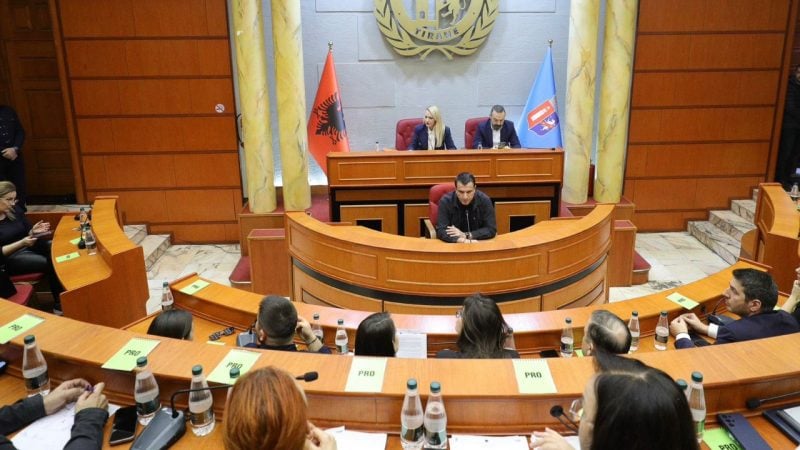
The main interested groups have been invited by the Parliamentary Media
Commission to discuss about the Draft Law for the Audio Visual Media.
They emphasized that the draft-law has essential inconsistencies, which
makes it impossible to be implemented in the deadlines set by the EU,
which requires that all operators pass from analog to digital broadcasts
by 2015.
The General Director of Digitalb, Alban Jaho, underlined that this project and its strategy have essential problems. According to Mr. Jaho, each existing analog operator should have the opportunity to create its own digital network for a transitory period, until 2015.
The first opportunity to be offered is the encouragement of free competition and the free choosing of the existing analog or digital operators.
“Since there is an obligation by the European Union for Albania to pass to the digital broadcast by 2015, and since it is impossible to undertake the transformation of the entire market, they deal only with the Albanian Public Television (TVSH), to be in order with this commitment. It is not the case, because even in the strategic point of view, there is no mentioning of the licensing of local or regional operators who must operate for the digital broadcast. Only the digitalization of TVSH is mentioned, but nothing about what will happen with the market, the existing operators or the new ones. We would enter a vicious circle again, which wouldn’t bring us anywhere. We propose to have a liberal digitalization process. There’s Italy as an example. Until 2015, every analog operator has the right to be digitalized, and this is very simple, because nothing has been thought about the infrastructure of analog operators, such as Top Channel, Klan or Vizion Plus. What will they do in 2015 with the equipments they have? No one has thought about such consequences and defects. When we start a digitalization process, on my opinion, the market is the one to be seen. When the digital market is converted, then all factors are harmonized”, Jaho declared.
The legal representative of “Top Media Group”, Sokol Nako, emphasized that it is a necessity to remove the limitation in the advertisements market, and also the implementation of harsher inspections, since the market is being threatened by piracy each day more.
“We have raised some concerns, such as that of the commercial limitations for the quantity of adverts that an operator can manage. We consider this as very unjust, because there is a legal and institutional structure that defends the competition in all sectors, and there was no reason for the media sector to be excluded. We raised the problem that the limitations for the media property priorities are now outdated, do not serve to the media purpose. Even in the current state, these are things of the past. We have suggested that this should change in the draft-law that was presented”, Nako declared.
The Head of the NCRT (National Council of Radio Television), Edlira Bushati, declared that the Draft Law for the Digital Broadcast should be regulated after the confirmation of the strategy. On the other hand, Mrs. Bushati underlined that the NCRT doesn’t have the structures for collecting fines from the subjects that commit piracy.
“We note that the sanctioning measure with a fine is exactly as the existing law. I agree with the private operators on this point, and with the Copyright Protection associations, that we must create harsher measures for the media piracy. The law provides that the execution of the fines should be made by the Bailiff Offices, which has left many decisions unsolved. What happens in practice? We remove their license with a decision, but we do not have equipments, human resources and legal competency to execute this decision. Today there are dozens of operators in the market that shouldn’t operate. We cannot address to the Tax Office, because they say that it is not their competency. For this reason, the inclusion of the Bailiff Service for the execution is really valuable”, Bushati declared.
In this meeting there were representatives of other interest groups, who asked an improvement of the law. The General Director of “Vizion Plus”, Genc Dulaku, emphasized that the frequency taxes are the highest in the region and NCRT has established limitations for the advertisement market for the current programs.
The General Director of the Albanian Public Television, Petrit Beci, declared that there are no implementation problems with this draft law, and that they will ask amends if the strategy will be approved as such.
The two main relators of the Draft-aw for the Audio Visual Media underlined that they accept the interest groups suggestions, and that they will work for synchronizing their requests with those of the European Union.
“The liberalization that the operators demand is a measure that could be achieved as soon as possible, and we will compare them with the conditions set by the EU. The synchronization of these requests would go in the same line with our purpose, which has the law implementation as a priority”, declared MP Alfred Dalipi.
The other relator, the Democratic MP, Mark Marku, declared that he agrees with the interest groups when they say that everyone should be in an open competition.
“The digital market must have competitive opportunities, without damaging the current interest groups, because they have a considerable part of this market and a role in the establishment of this market in Albania”.
Top Channel