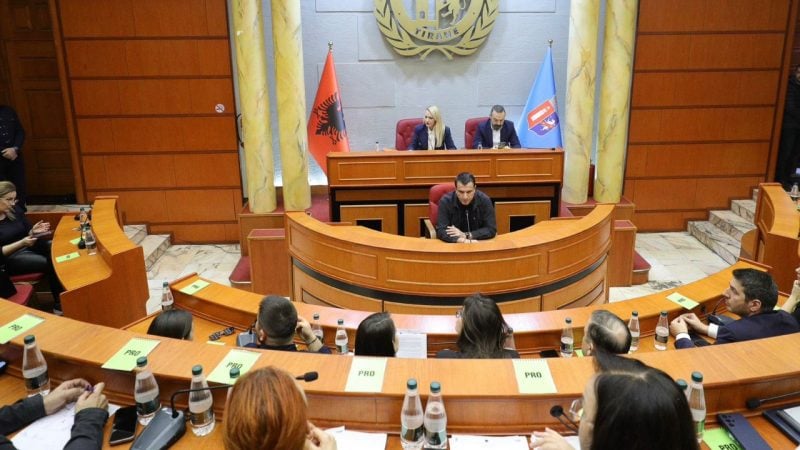
EU-Albania meeting
12/07/2012 00:00



The news for the electoral reform was welcomed in Brussels, but during
the inter-parliamentary meeting it was identified that too much work is
still to be done.
The debate was characterized by the Albanian majority presenting its achievements and the repeated request of the European Commission for concrete results in all fields.
Reform and Parliamentary developments
Ditmir Bushati, chairman of the Parliamentary Commission for Integration:
Yes, the electoral reform is being finalized, but only the lawmaking process, and the Commission, the member states have taught us in order to measure our progress in terms of real implementation, in terms of the impact in the citizens’ life, not in terms of number of laws and decisions of the Council of Ministers has passed.
Fatos Beja, Co-chairman of the European Parliament Committee EU-Albania
Albania has done evident progress in all the issues mentioned in this article, such as the consolidation of democracy, the rule of law, and the market economy.
Ditmir Bushati: We have made some steps, but we are yet behind with the so called critical mass. Again, I want to make an appeal. The candidate status? Yes, I’d like the accession talks. I appeal for accession talks. I need, as a member of the opposition, I need chapter 23 and 24, because I am sure that there will be much more leverage also for the Albanian opposition, and I am sure that in a one year time we will win the elections and we would like Albania to have a candidate status and to proceed with the accession talks and so on, because this would have a positive effect on the Albanians’ daily life.
Fatos Beja: If we say that we don’t have concrete results in the reforms and the priorities, I would say that this is hard to believe, because if you see the priorities, we have made steps ahead in all priorities.
Stefano Sannino, general director for enlargement at the EC:
In our regular consultations with the Albanian authorities, we are witnessing an amount of progress in a number of areas, but it is evident that further tangible results are required in the upcoming weeks and months, and in particularly movement of the functioning of law, the politicizing of the public administration, the reform of the judicial fight against organized crime and corruption, and all the key challenges for Albania.
Eduard Kukan, Co-Chairman of the European Parliament-Albania Committee:
A lot of time was invested already, so that’s why the Parliament now needs to work really efficiently. There are reforms, such as the Parliamentary Rules of Procedure, and the reform of the judiciary that are of crucial importance as well.
The judiciary
Saimir Tahiri, SP: “I am one of the 10 Socialist Party MPs that today are punished by judicial trials in the Albanian courts, due to the declarations made as Albanian MP. Today, as we speak, there are 18 trials against 10 Socialist Party MPs, three of whom are here. The punishment demanded from us goes more than 1 million EUR. I started with this for showing that there are two standards in Albania, and both of them are part of the same illness: the lack of independence in court, the politicization of the judicial system, the submission of the judicial system to the political pressure, power and money. These are two standards: the impunity system on one hand, if you are a high rank official, MP or Minister, or a relative of the government members, and you will never get punished for crimes or corruption. On the other hand, if you raise the finger against those who commit a crime while on duty, you are punished for reporting them. You can see on TV a Minister who asks sexual favors from a student that is looking for a job, and the Minister is not punished, but the TV that broadcasted it. You can write critical articles against the government, but your car will be burned, your newspaper will be closed and you can be beaten in public. These are the phenomena we are living with”.
Arenca Trashani, DP: “I don’t want to debate with my colleague, but he is the only person who shouldn’t talk about this, since there a conflict of interest. Mr. Tahiri is sued for slander in the Tirana court. The judicial reform is based and oriented by basic principles, such as the judicial independence, the responsibility of judges and transparency, and a very important criterion, the trust of the citizens to this administration”.
Vasilis Maragos, Head Unit for Albania at the EC:
The pace of reforms in the area of the judiciary and also in areas like the fight against corruption and the organized crime, will also define to a great extent the pace Albania’s integration or other countries to the European Union. I really liked to encourage all states involved, including those present in this room, but also back in Tirana, the main decision makers, but also the judges, to work towards building a national consensus in the fights of all these phenomena, and strengthening the performance of all institutions in the rule of law. It is of the outmost importance that Albania moves forward in this field.
Economy
Mimi Kodheli, SP: “The greatest danger today for the macro-economic stability of Albania is the stock of the public debt that according to the official data goes to 60% of the GDP, much more than the average of the regional countries. The budget deficit keeps growing in a frightening way even today, after the data of the first five months of 2012, in which it has increased with 240%. In a time when the biggest concern is the inner deficit, which only for the first five months has increased with 793% and the domestic loans have reached 1000%, only for the first half of 2012. The bad loans have reached 21% of the Albanian banks’ portfolio, which means that the economy and the Albanian business are facing a big problem that goes beyond the liquidity problem, which today is being absorbed only by the Albanian government for covering their budget deficit.
Florian Mima, DP: “I have made a commitment to myself not to debate or react to any phrase or thought of the colleagues from the Socialist Party, and I will honor that commitment, I will not do that. But I will honor more the truth. Now let’s go back to the non performing loans. Can someone in this office tell me what the government has to do with the level of non-performing loans? They are loans delivered by the banks to private companies and are not honored by the companies. So, what’s the role of the government? I am telling you that the idea of the opposition was to push people to go back to the banks and withdraw their deposits. People were smart enough not to listen to the opposition.
Arben Malaj, SP: For not charging the debate with a political confrontation even in this honored room, we could have a better help from the international indexes that assess the progress of our country in the most essential reforms. If we see the index of economic freedom, the property rights are under the “oppressed right” level, which hampers the economic progress of the country. The independence of the judiciary or the corruption level is to the extent that for the economic freedom is considered an “oppressed freedom”. If you asked Mrs. Kodheli of what we can do, based on the deterioration of bad loans, this is exactly what we should do: liberating the economic development of our country from these real obstacles.
Sannino: “As regards the economy, I’d like to acknowledge that Albania has maintained a macro-economic stability, and despite the crisis, its economy continues to grow, although with a slower pace than in the previous years. Albania now needs to keep on working and make further steps in the structural reforms and the fiscal consolidation, in order to make sure that the economic growth and the stability can be based on solid foundations.
Free speech and media
Sannino: “Freedom of expression is another fundamental right and a key component of the Copenhagen Political Criteria, and as such it is followed very closely by the European Commission, including when it comes to media freedom. We believe that in Albania, the freedom of expression continues to be respected. A positive element is the decriminalization of defamation, and we are encouraging the authorities and the interested parties to remove the remaining obstacles and further enhance media transparency, independence, freedom and professionalism. This includes also the adoption of the law on audio-visual media, which is pending in Parliament”.
Valentina Leskaj: “A number of reports by specialized agencies on the freedom of media are alarm signals for the failure of the government to implement the law. Allow me to mention only four reports: the Freedom House Report, Reporters Without Borders, IREX and the US State Department report which are very critical, and the last one is the visit of a high representative of the media in the OSCE, Dunia Mijatovic, who was also very critical to the media issue. As Mr. Sannino previously mentioned, we are concerned about the electronic media law which is pending in Parliament. As opposition we are pushing almost every day to pass it, because this law has been prepared with the assistance of the EU, the EC and OSCE.
The electoral reform, together with the Ombudsman and the passing of qualified majority laws, are only part of the 12 famous priorities that Albania must fulfill. Besides the passing of the laws, the country must prove in that little time that has remained until autumn, that the laws have been implemented and that there have been tangible results for deserving the candidate status. By the end of the two-day discussions, the Stabilization and Association Committee EP-Albania approved without changes the mutual eight-point declaration that was published last week by Top Channel. The next meeting of the committee will be held in Tirana on December 19th and 20th.
Prepared by: Arta Tozaj
Top Channel